Surfaces Built to Direct Water Away
Grading in Taylorsville for proper drainage, erosion control, and stable construction surfaces
Incorrect grading creates water pooling near foundations, driveway washouts, and unstable building pads that shift under load. Precision grading establishes slopes that direct runoff away from structures, prevent erosion during heavy rain events common in Alexander and Catawba counties, and provide stable subgrade for foundations, driveways and pavement. Full Time Grading & Excavating operates equipment with accuracy that achieves specified elevations and slope percentages, producing graded surfaces that perform correctly long after construction concludes.
Grading work involves cutting high areas, filling low spots, and shaping soil to designed slopes using GPS-assisted equipment or manual grade checking depending on project precision requirements. The process prepares sites for home construction, shapes driveway routes to prevent washouts, and corrects existing drainage problems where water flows toward buildings instead of away. Quality grading prevents the settling, erosion, and water damage that result when soil is simply pushed around without engineered slope control.
Contact the team to receive a grading estimate based on site measurements and drainage objectives.
What Proper Grading Requires
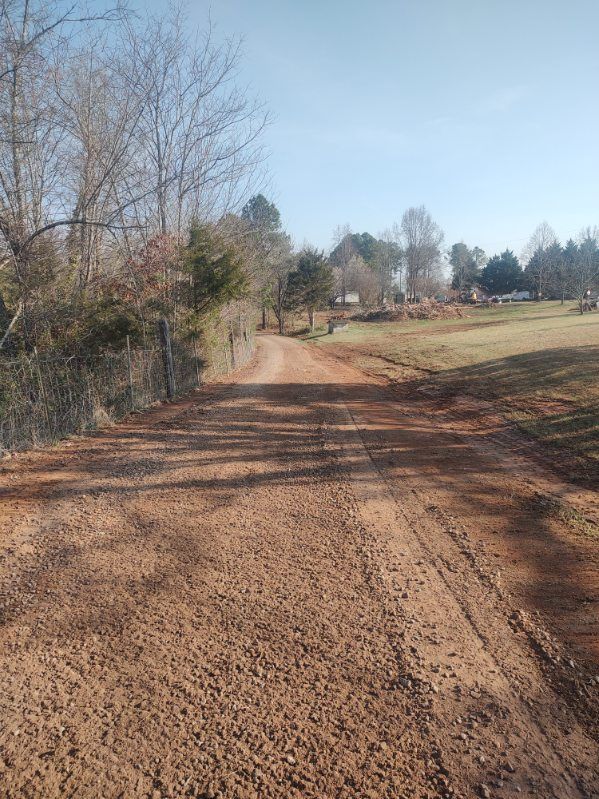
The grading process begins with survey data or site assessment that identifies existing elevations, drainage patterns, and problem areas where water currently pools or erodes soil. Equipment operation follows planned slopes, with multiple passes used to compact fill areas and achieve uniform density that prevents future settling. For building pads, grading creates level surfaces within tolerance specifications, while for drainage swales and driveway approaches, grading establishes consistent slopes that move water predictably without creating erosion channels.
After grading, water flows visibly away from structures during rain events, driveways shed runoff to sides rather than channeling flow down the center, and building pads remain level without low spots that collect standing water. The surface is stable enough for immediate construction activity or ready for final topsoil and seeding depending on project phase. Erosion control measures like silt fencing or seeding are often added after rough grading to protect exposed soil until construction completes.
Grading quality depends on operator skill and equipment precision, not just moving dirt quickly. Slopes must match design specifications to function correctly, compaction must reach adequate density to support loads, and final surfaces must tie into existing grades without creating abrupt transitions that concentrate water flow or create tripping hazards.
Questions Before Starting Your Project
Homeowners and contractors preparing construction sites throughout Alexander County, Catawba County, and Caldwell County frequently ask about grading specifications and long-term performance.
What slope percentages are used for different grading applications?
Building pad areas are graded to within one percent of level to prevent floor slope issues, while drainage swales use two to four percent slopes that move water without causing erosion, and driveway grades depend on length and terrain but typically stay below ten percent for traction and safety.
How does soil type affect grading and compaction requirements?
Clay soils common in the Taylorsville area hold shape well but drain slowly, requiring swale grading or subsurface drainage in some cases, while sandy soils compact less predictably and may need geotextile reinforcement under driveways or building pads.
When should grading occur during the construction process?
Rough grading happens after site clearing and utility trenching but before foundation construction, with final grading completed after building work to establish finish slopes around the structure and connect to driveways and walkways.
What causes graded surfaces to settle or erode after completion?
Settlement occurs when fill soil isn't compacted in lifts during placement, and erosion develops when slopes exceed soil's natural angle of repose or when runoff concentrates into channels instead of spreading across vegetated areas.
How is grading verified to meet design specifications?
Grade checking uses laser levels, string lines, or GPS equipment to confirm elevations match plans at multiple points, with compaction tested using probe rods or plate compactors to ensure adequate density before construction proceeds.
Full Time Grading & Excavating completes grading for residential and commercial projects with attention to drainage performance and long-term site stability. Reach out with your project location and grading scope to discuss site-specific requirements and schedule work that aligns with your construction timeline.